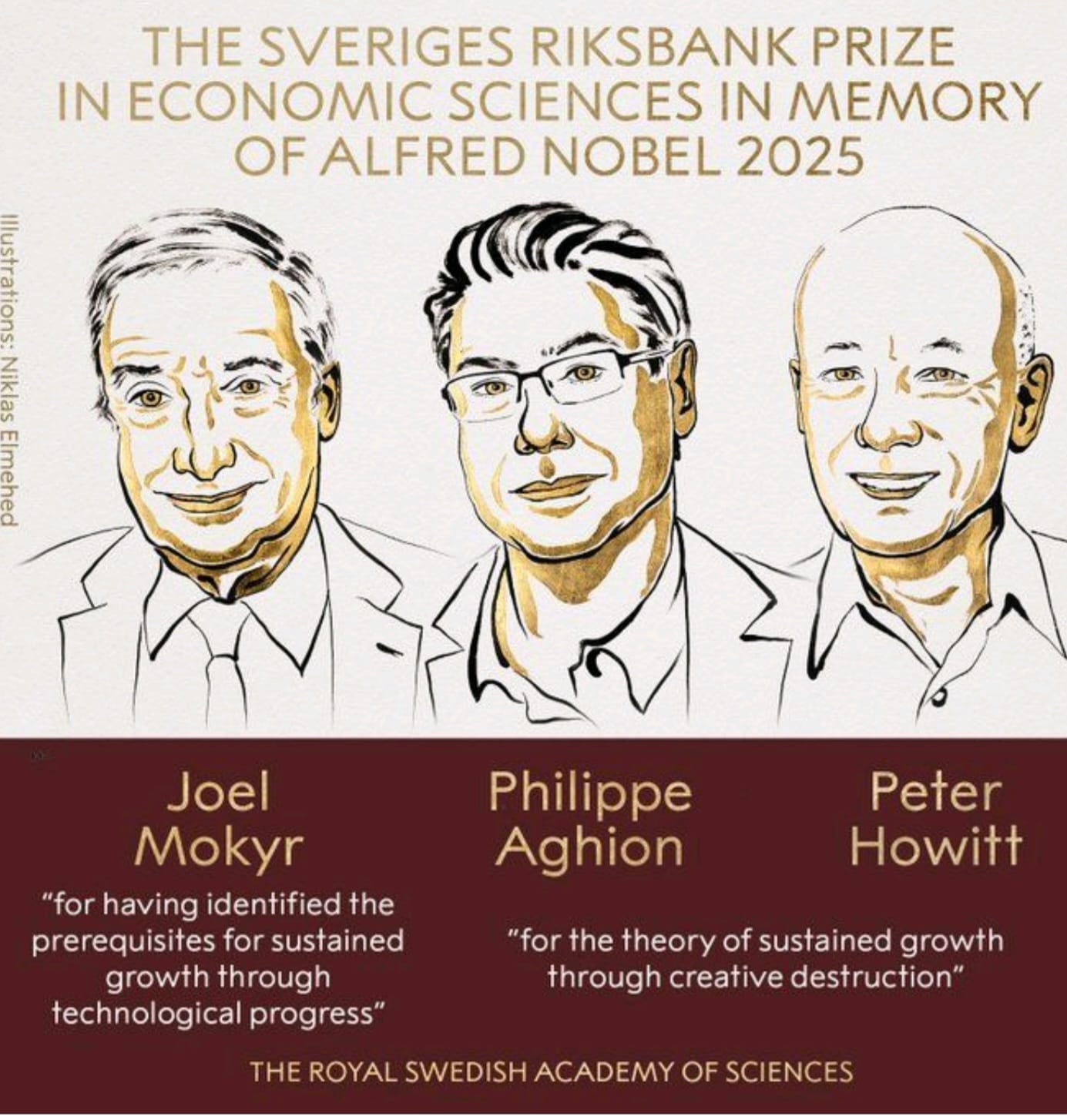
India’s economic story in 2025 is one of dazzling potential shadowed by deep structural fragility — a paradox that the ideas of Nobel laureates Joel Mokyr, Philippe Aghion, and Peter Howitt help illuminate with remarkable clarity. Mokyr would remind us that technological progress alone does not guarantee prosperity; it thrives only when supported by institutions that nurture inquiry, protect knowledge, and ensure the broad diffusion of ideas. India’s rapid digitalization, entrepreneurial surge, and advances in green energy and AI demonstrate enormous capacity for technological creativity. Yet, echoing Mokyr’s argument in The Lever of Riches (1990) and A Culture of Growth (2016), such progress will remain fragile without the institutional scaffolding that sustains innovation — an education system that prizes critical thought, a bureaucracy that values transparency, and a social fabric that rewards experimentation over conformity. In Mokyr’s historical lens, nations that transformed invention into enduring growth did so by cultivating trust, openness, and intellectual freedom — qualities India still struggles to institutionalize.
From the theoretical vantage of Aghion and Howitt, India’s transformation reflects the exhilarating but perilous dynamic of creative destruction. Their seminal Econometrica paper “A Model of Growth through Creative Destruction” (1992) formalized Joseph Schumpeter’s intuition that progress depends on the continuous replacement of old technologies with new ones — a process that fuels productivity but displaces workers and disrupts established firms. Today, India’s booming tech and service sectors, its digital commerce revolution, and its shift toward renewable industries exemplify this churn. But Aghion and Howitt’s framework warns that innovation-driven growth can backfire if competition is stifled, if the reallocation of labor and capital is inefficient, or if the victims of disruption are left behind. In India, chronic unemployment, especially among youth, weak social welfare systems, and underfunded labor retraining schemes reveal precisely this tension between innovation and inclusion.
Data from the World Inequality Database underscore the stakes: India has one of the highest levels of wealth and income concentration globally, with the top 1 percent capturing more than 20 percent of total income and around 40 percent of wealth. Such disparity reflects what Aghion (2021) calls “the dark side of creative destruction” — when innovation rents accumulate without effective redistribution or competition policy. The welfare architecture remains insufficient to cushion the displaced, and the persistence of informal labor markets magnifies the risks of automation and digital exclusion. Mokyr’s historical work reminds us that societies failing to share the gains of progress often saw innovation itself stagnate, as inequality eroded trust and social cohesion.
For India, the path forward requires what Aghion and Howitt (1998) term a “dynamic equilibrium of renewal” — where policies encourage entrepreneurship and competition while ensuring that the benefits of technological change are widely distributed. This means reforming institutions to make them transparent and accountable, linking welfare to skill development, and investing heavily in human capital and R&D. India’s demographic dividend and vibrant startup ecosystem offer a powerful foundation, but without strong governance, inclusive welfare, and equitable access to opportunity, the cycle of creative destruction could deepen divides instead of bridging them.
In the spirit of Mokyr’s historical wisdom and Aghion and Howitt’s growth theory, India’s future will depend not merely on how fast it innovates, but on how well it governs innovation. Economic growth in the twenty-first century is not simply about producing new technologies — it is about producing fair institutions that allow creativity to flourish across all classes. If India can transform creative destruction into constructive creation — combining growth with justice, innovation with inclusion — it could become not only an engine of prosperity, but a model for equitable modernization in the Global South.
Joel Mokyr
- Mokyr, Joel. The Lever of Riches: Technological Creativity and Economic Progress. New York: Oxford University Press, 1990.
- ———. The Gifts of Athena: Historical Origins of the Knowledge Economy. Princeton, NJ: Princeton University Press, 2002.
- ———. A Culture of Growth: The Origins of the Modern Economy. Princeton, NJ: Princeton University Press, 2016.
Philippe Aghion & Peter Howitt
- Aghion, Philippe, and Peter W. Howitt. “A Model of Growth through Creative Destruction.” Econometrica 60, no. 2 (1992): 323–351.
- ———. Endogenous Growth Theory. Cambridge, MA: MIT Press, 1998.
- Aghion, Philippe, Céline Antonin, and Simon Bunel. The Power of Creative Destruction: Economic Upheaval and the Wealth of Nations. Cambridge, MA: Harvard University Press, 2021.
Peter Howitt
- Howitt, Peter. “Steady Endogenous Growth with Population and R&D Inputs Growing.” Journal of Political Economy 107, no. 4 (1999): 715–730.

Leave a Reply