The Role of Sentiments in Geopolitical Risk
In today’s hyperconnected world, geopolitics doesn’t just live in diplomatic cables or military outposts—it reverberates through the stock markets, bond yields, and global investor sentiments. The emotional undercurrent behind these reactions—investor sentiment—plays a critical yet often underestimated role in amplifying or muting the impact of geopolitical risk on financial stability.
Sentiment as a Transmission Channel
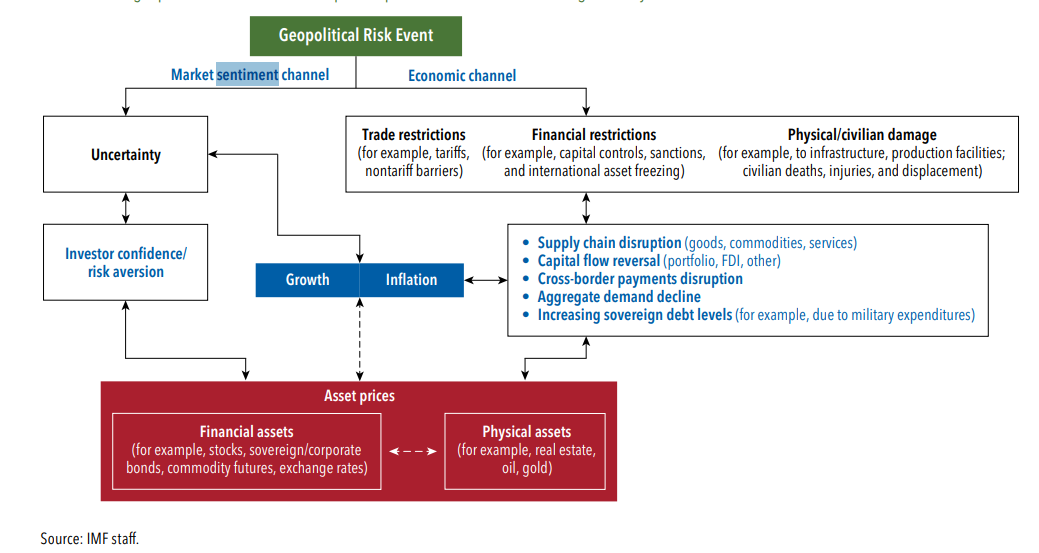
Geopolitical risk encompasses threats like war, terrorism, and political upheaval. While the economic consequences of these events—disrupted trade, capital flight, and inflation—are measurable, the intangible sentiment that accompanies uncertainty is just as important. According to the IMF’s April 2025 Global Financial Stability Report, geopolitical shocks influence markets via two main channels:
1. The economic channel (through trade, capital flows, and macro fundamentals)
2. The sentiment channel (through investor confidence and risk aversion)
Even when a conflict is only looming and not yet realized, fear alone can lead to sharp market corrections. Investor sentiment drives volatility indexes like the VIX higher, spurs capital flight from emerging markets, and triggers sell-offs in equities—particularly in sectors sensitive to global stability, such as technology or consumer discretionary.
How Markets React to Sentiment-Driven Risk
Historical data reveals that the emotional component of geopolitical risk can cause disproportionately large reactions in asset prices. For instance, while the average market reaction to geopolitical risk is modest (around a 3% stock market drop), more severe or high-profile events—such as Russia’s 2022 invasion of Ukraine—triggered drops of 9% or more across global markets. These aren’t just economic calculations; they’re reactions to fear, uncertainty, and perceived instability.
Investor sentiment also contributes to contagion effects—where geopolitical stress in one region (say, Eastern Europe) spreads to unrelated markets through panic-driven reallocations of capital. Even firms not directly exposed to the affected region may suffer stock price losses due to deteriorating global risk appetite.
Pricing Risk: When Fear Meets Finance
A key takeaway from the IMF report is that investors do, to some extent, price in geopolitical risk. Stocks that are more sensitive to geopolitical uncertainty tend to offer higher risk premiums. However, because these events are rare and unpredictable, market participants often rely on heuristics, reacting emotionally rather than rationally—a classic feature of sentiment-driven behavior.
This behavioral dimension leads to overcorrections during crises and complacency during prolonged periods of tension without actual conflict. Such sentiment cycles can sow seeds of instability, catching markets off guard when risks materialize.
Measuring Volatile Sentiments
The impact of sentiments on financial market behaviour has drawn attention from a diverse body of literature.. Robert Shiller’s Narrative Economics (2017) highlights how emotionally compelling stories—often untethered from hard data—can shape economic outcomes by spreading like epidemics, influencing behavior at scale. Paul Tetlock (2007) demonstrates that the tone of media coverage, particularly pessimism, significantly impacts short-term stock returns, revealing how sentiment-laden news can move markets. Expanding on this, Barber and Odean (2008) and Da, Engelberg, and Gao (2011) show that investor behavior is often driven by attention—not fundamentals—and that emotionally charged narratives tend to attract disproportionate market activity. In the realm of corporate governance, Brav, Jiang,and Kim (2015), along with Krüger (2015), find that shareholder activism rooted in ESG concerns and social justice can materially influence stock prices, underscoring the market power of emotionally resonant framing. Finally, Andrew Lo’s Adaptive Markets Hypothesis (2012) proposes that markets are not purely rational systems but evolve in response to changing cognitive and emotional forces, and hence sentiment emerges as a core component of market dynamics. While the impact of emotion on markets has long been observed, it has remained difficult to quantify.
Can we quantify?
A relatively straightforward scorecard based model to quantify emotional volatility is recently proposed in Roy (2025) who argues that emotion is not just reactive but endogenous and systemic, particularly in the age of meme stocks, social media virality, and polarized discourse. EVI reframes emotion as a structural force rather than transient noise. He suggests the need for constructing an Emotional Volatility Index (EVI), to quantify emotional risk in financial markets. This model acts both as a sentiment radar and an emotion stress test, allowing detection of emotionally-driven dislocations—such as the sharp Tesla correction in early 2025, where sentiment outweighed fundamentals. https://papers.ssrn.com/sol3/papers.cfm?abstract_id=5210230
Policy Implications
As the recent IMF Global Financial Stability Report ( April 2025, Chapter 2, page 5) observes :
“A second channel through which increases in geopolitical risk can affect prices of financial assets is the market sentiment channel. Such increases may raise macroeconomic and financial uncertainty even if no conflict or policy change has been realized, with an impact on asset prices through a decline in investor confidence and an increase in risk aversion” .
For policymakers and financial institutions, acknowledging the role of sentiment is critical. Sentiment-driven volatility can erode liquidity, trigger fire sales, and undermine the solvency of leveraged institutions. Therefore, regulators and market participants should:
• Monitor sentiment indicators alongside traditional risk metrics
• Strengthen liquidity and capital buffers to prepare for emotional shocks
• Promote financial literacy to reduce herding and panic during crises
Final Thoughts
Geopolitical risks are here to stay—but their financial impact is not solely a matter of hard economics. Investor sentiment, often emotional and erratic, shapes how deeply these risks ripple through the markets. Understanding and accounting for this human factor is key to building more resilient financial systems in an increasingly uncertain world.
References
Baker, Malcolm, and Jeffrey Wurgler. “Investor Sentiment and the Cross-Section of Stock Returns.” Journal of Finance 61, no. 4 (2006): 1645–1680. https://www.jstor.org/stable/3874723
Barber, Brad M., and Terrance Odean. “All That Glitters: The Effect of Attention and News on the Buying Behavior of Individual and Institutional Investors.” Review of Financial Studies 21 (2008): 785–818.
Barberis, Nicholas, Andrei Shleifer, and Robert Vishny. “A Model of Investor Sentiment.” Journal of Financial Economics 49, no. 3 (1998): 307–343. https://scholar.harvard.edu/files/shleifer/files/model_invest_sent.pdf
Brav, Alon, Wei Jiang, Frank Partnoy, and Randall Thomas. “Hedge Fund Activism, Corporate Governance, and Firm Performance.” Journal of Finance 63, no. 4 (2008): 1729–1775. https://papers.ssrn.com/sol3/papers.cfm?abstract_id=948907
Da, Zhi, Joseph Engelberg, and Pengjie Gao. “In Search of Attention.” Journal of Finance 66, no. 4 (2011): 1461–1499. https://onlinelibrary.wiley.com/doi/full/10.1111/j.1540-6261.2011.01679.x
Goranova, Maria, and Lori Verstegen Ryan. “Shareholder Activism: A Multidisciplinary Review.” Journal of Management 40, no. 5 (2014): 1230–1268. https://papers.ssrn.com/sol3/papers.cfm?abstract_id=2384280
International Monetary Fund. Global Financial Stability Report: Geopolitical Risks—Implications for Asset Prices and Financial Stability, Chapter 2. April 2025. Washington, DC: IMF. https://www.imf.org/en/Publications/GFSR
Krüger, Philipp. “Corporate Goodness and Shareholder Wealth.” Journal of Financial Economics 115, no. 2 (2015): 304–329. https://ideas.repec.org/a/eee/jfinec/v115y2015i2p304-329.html
Lo, Andrew W. “Adaptive Markets and the New World Order.” Financial Analysts Journal 68, no. 2 (2012): 18–29. https://dspace.mit.edu/handle/1721.1/75362
Roy, Shlok. “Emotional Volatility Index (EVI): A Framework for Quantifying Sentiment Risk in Financial Markets.” SSRN, March 18, 2025. https://papers.ssrn.com/sol3/papers.cfm?abstract_id=5210230
Shiller, Robert J. “Narrative Economics.” Cowles Foundation Discussion Paper No. 2069, Yale University, 2017. https://cowles.yale.edu/sites/default/files/files/pub/d20/d2069.pdf
Tetlock, Paul C. “Giving Content to Investor Sentiment: The Role of Media in the Stock Market.” Journal of Finance 62, no. 3 (2007): 1139–1168. https://onlinelibrary.wiley.com/doi/abs/10.1111/j.1540-6261.2007.01232.x



Leave a Reply