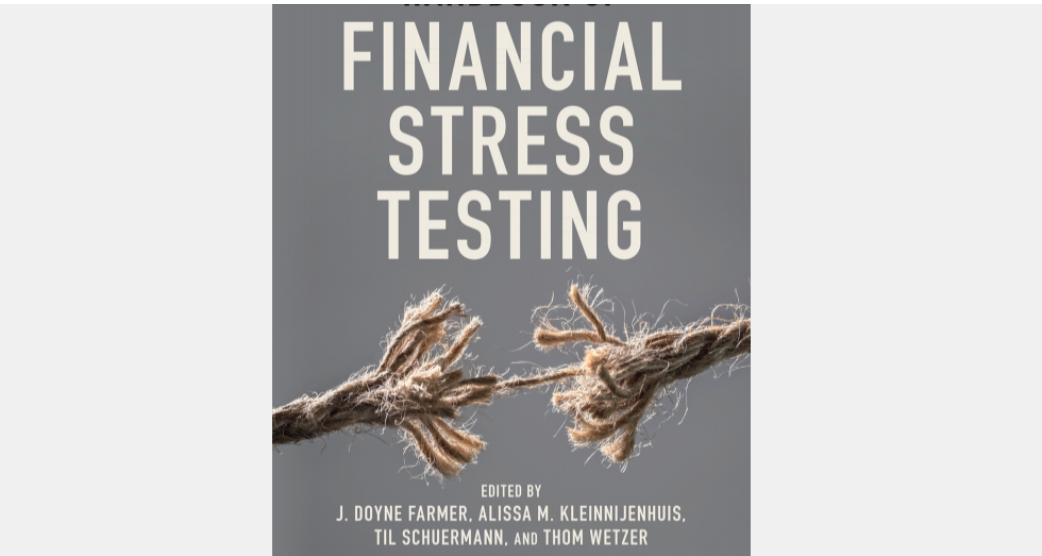
Financial stress testing has become an indispensable tool in the post-2008 regulatory and financial landscape, guiding institutions, policymakers, and analysts in understanding vulnerabilities and preparing for systemic shocks. The Handbook of Financial Stress Testing, edited by J. Doyne Farmer, Alissa M. Kleinnijenhuis, Til Schuermann, and Thom Wetzer, provides a comprehensive and interdisciplinary exploration of this critical subject. Published by Cambridge University Press, the book is a must-read for financial professionals, regulators, and academics who aim to grasp the evolving methodologies and applications of stress testing.
The book begins with an insightful introduction that sets the stage for understanding financial stress testing as both a regulatory necessity and a strategic tool. The editors outline how stress testing has evolved into a multidisciplinary field, integrating insights from finance, economics, and data science. The 2008 financial crisis served as a watershed moment, exposing weaknesses in traditional risk management and necessitating more rigorous approaches to assessing financial stability. This opening chapter establishes the book’s objectives—bridging theory and practice while addressing contemporary challenges such as climate-related financial risks and digital finance.
One of the most compelling chapters is the historical perspective on stress testing. The book traces its origins from engineering applications—where stress tests evaluate material durability—to its financial applications that emerged in the 1990s. The financial sector initially used stress testing to gauge portfolio risks, but its role expanded significantly after the global financial crisis. The chapter examines how regulatory frameworks like the Federal Reserve’s Comprehensive Capital Analysis and Review (CCAR) and the European Banking Authority’s stress tests institutionalized stress testing, embedding it into global financial governance.
Understanding the objectives of stress testing is essential, and the book delves into its dual nature—microprudential and macroprudential. Microprudential stress testing ensures individual financial institutions maintain solvency and liquidity during adverse conditions, focusing on capital adequacy and risk-weighted assets. On the other hand, macroprudential stress testing assesses systemic risk, considering factors like contagion, interconnectedness, and financial market stability.
This chapter highlights the necessity of balancing these objectives to strengthen both institutional and systemic resilience.
A key strength of the Handbook of Financial Stress Testing is its deep dive into scenario design. Effective stress testing relies on the development of plausible yet severe economic scenarios, incorporating macroeconomic variables like GDP growth, unemployment rates, inflation, and interest rates. The book discusses how historical crises inform stress testing methodologies while emphasizing the importance of forward-looking scenarios to capture emerging risks such as geopolitical instability or pandemics. Scenario design plays a crucial role in regulatory exercises, ensuring financial institutions prepare for worst-case scenarios while maintaining operational flexibility.
The discussion of modeling financial systems is another highlight of the book. Stress testing requires sophisticated models to translate economic scenarios into financial impacts. The book explores various modeling approaches, including econometric models that link macroeconomic variables to financial losses, agent-based models that simulate the behavior of individual economic agents, and network models that map interconnections within the financial system to assess contagion risks. By comparing these models, the book provides valuable insights into their respective strengths and weaknesses, emphasizing that a combination of approaches is often necessary to achieve robust risk assessments.
An often-overlooked area in stress testing is the role of central counterparties (CCPs), and the book dedicates an entire chapter to this crucial subject. CCPs act as intermediaries in financial markets, mitigating counterparty risk in derivatives trading. However, their systemic importance necessitates specialized stress testing methodologies to evaluate risks such as liquidity shortages and default waterfalls. The book examines regulatory frameworks designed to enhance the resilience of CCPs, recognizing their pivotal role in maintaining market stability.
One of the most forward-looking chapters addresses climate-related financial risks. As climate change increasingly affects global finance, stress testing must adapt to incorporate both physical risks (e.g., extreme weather events damaging assets) and transition risks (e.g., policy shifts affecting carbon-intensive industries). The book discusses innovative methodologies for integrating climate data into stress tests, acknowledging the challenges posed by long-term time horizons and uncertainties surrounding climate policy. Climate stress testing represents a rapidly evolving area, requiring new models and data sources to ensure financial institutions can adapt to environmental shifts.
Another vital aspect of stress testing explored in the book is the role of heterogeneity in financial institutions. The financial landscape is diverse, with banks, insurance companies, and asset managers exhibiting different risk profiles. The book argues that stress testing should account for these differences to avoid oversimplification. Large banks classified as “too big to fail” pose systemic risks that require different stress testing approaches compared to smaller institutions with niche exposures. By recognizing heterogeneity, stress tests can better capture the nuances of financial stability.
The book also provides a practical guide to implementing stress testing, showcasing real-world applications like the Federal Reserve’s CCAR and the European Banking Authority’s stress tests. This chapter details the operational workflow involved in stress testing, from data collection and model implementation to scenario execution and regulatory reporting. The insights from practitioners highlight challenges such as data limitations, model uncertainty, and coordination among regulatory bodies. Real-world case studies demonstrate how stress testing has evolved to become a fundamental component of financial supervision.
In its concluding chapter, the book explores the future of stress testing. With advancements in artificial intelligence and machine learning, stress testing is poised to become more dynamic and predictive. Real-time data integration, enhanced pattern recognition, and adaptive scenario modeling represent the next frontier. Additionally, stress testing must continue evolving to address emerging risks such as cyber threats and cryptocurrency volatility. The book calls for continuous collaboration between researchers, regulators, and financial institutions to refine stress testing methodologies, ensuring they remain relevant in an ever-changing financial landscape.
Throughout chapters dealing with diverse issues of stress testing, the Handbook of Financial Stress Testing offers an in-depth discussion of stress testing models. It categorizes key models into econometric, agent-based, and network-based approaches, emphasizing the need for integration to achieve robust risk assessments. Challenges such as model risk, data constraints, and complexity are addressed, reinforcing the importance of transparency and validation in stress testing practices. Real-world examples, such as CCAR, illustrate how these models are deployed in practice, providing readers with a practical understanding of their applications.


Leave a Reply