The Macro-Theoretical Context of Stagflation
Stagflation, characterized by simultaneous high inflation, stagnant economic growth, and elevated unemployment, poses a unique challenge to economic theory and policy. Traditionally, the Phillips Curve suggested an inverse relationship between inflation and unemployment, but stagflation, as seen in the 1970s oil shocks, defies this framework. Today, the U.S. economy faces stagflation risks driven by trade disruptions and policy uncertainties, particularly tariffs. To understand this phenomenon, we integrate insights from New Classical, Post-Keynesian, and Real Business Cycle (RBC) theories.
RBC theory, a cornerstone of modern macroeconomics, posits that economic fluctuations are primarily driven by real shocks to technology, productivity, or supply conditions, rather than demand-side factors. Unlike Keynesian models, RBC assumes flexible prices and wages, with agents optimizing in response to shocks. In a stagflation context, RBC suggests that negative supply shocks—such as tariff-induced cost increases or supply chain disruptions—reduce total factor productivity, lower output, and elevate prices. These shocks align with the current economic environment, where trade policies threaten to disrupt production and inflate costs.
New Classical economics complements RBC by emphasizing the role of expectations. If firms and consumers anticipate persistent inflation due to tariffs or policy uncertainty, they may adjust pricing and wage demands, entrenching inflation. Post-Keynesian perspectives highlight structural factors, such as trade barriers, that choke supply chains and reduce capacity. Together, these frameworks provide a robust lens for analyzing the stagflation risks articulated by Federal Reserve Chair Jerome Powell and economist Raghuram Rajan.
Powell’s Perspective: Tariffs as a Supply Shock
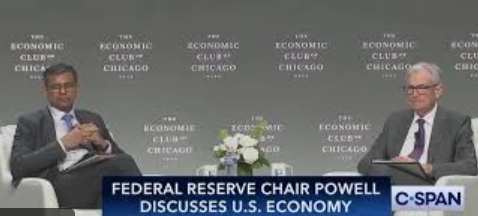
Federal Reserve Chair Jerome Powell has raised alarms about stagflation risks stemming from the Trump administration’s expansive tariff policies. Speaking at the Economic Club of Chicago a few days back, Powell described these tariffs as “significantly larger than anticipated,” warning that they could simultaneously drive inflation and slow growth. This scenario threatens the Fed’s dual mandate of maximum employment and price stability.
From an RBC perspective, tariffs act as a negative supply shock, akin to a technological regress. By increasing the cost of imported inputs, tariffs reduce firms’ productivity. Real shocks disrupt the economy’s production function, causing stagflation-like conditions. Powell noted that the inflationary effects of tariffs might be temporary but could persist if trade disruptions endure, a concern echoed in recent Federal Open Market Committee discussions.
Rajan’s Caution: Recession and Institutional Risks
Raghuram Rajan, former Governor of the Reserve Bank of India and a professor at the University of Chicago Booth School of Business, has warned that the U.S. faces a chance of recession due to tariff policies. Rajan argued that tariffs could contract economic activity by raising costs and disrupting supply chains.
RBC theory supports Rajan’s concerns by framing tariffs as a shock to the economy’s productive capacity. In RBC models, such shocks reduce the capital stock’s efficiency, leading to lower output and higher prices—hallmarks of stagflation. Rajan’s recession warning aligns with RBC’s prediction that persistent supply shocks can trigger prolonged downturns, particularly if firms reduce investment in response to higher costs.
Rajan’s emphasis on central bank independence resonates with New Classical insights about expectations. In RBC models, while monetary policy is neutral in the long run, short-term credibility matters for stabilizing expectations. Undermining the Fed’s autonomy could amplify uncertainty, causing firms to hoard resources or delay investment, further depressing productivity. Moreover, structural damage from trade fragmentationmay reinforce supply-side constraints.
Policy Implications: Navigating Supply-Driven Fluctuations
Powell and Rajan’s warnings underscore the complexity of addressing stagflation in a supply-constrained environment. RBC theory suggests that monetary policy is ill-equipped to counter real shocks, as interest rate adjustments primarily affect demand. The Fed’s cautious stance, as articulated by Powell, reflects this limitation, with policy decisions hinging on clarity about trade policy impacts.
To mitigate stagflation, RBC theory advocates addressing the root causes of supply shocks. Fiscal policies, such as subsidies for affected industries or investments in supply chain resilience, could restore productivity, aligning with Post-Keynesian calls for structural reforms. However, political polarization over trade policy complicates such measures. Rajan’s focus on central bank independence highlights the need to maintain credible institutions to anchor expectations, preventing a feedback loop of inflation and stagnation.
International coordination to stabilize global trade could also alleviate supply shocks, a point implicit in RBC’s emphasis on productivity. By reducing tariff-related disruptions, policymakers could restore the economy’s productive capacity, mitigating stagflationary pressures.
Conclusion: A Prudent Path Forward
The insights from Jerome Powell and Raghuram Rajan, viewed through the lens of macroeconomic theory, illuminate the stagflation risks facing the U.S. in 2025. Tariffs, as negative supply shocks, threaten to reduce productivity, elevate prices, and stagnate growth. Addressing stagflation requires tackling supply-side constraints through targeted fiscal measures and international cooperation, while preserving central bank credibility to manage expectations. As the U.S. ( and the world) navigates this challenging landscape, prudent, data-driven decisions and a commitment to economic stability will be critical to averting a prolonged period of stagnation and inflation.



Leave a Reply