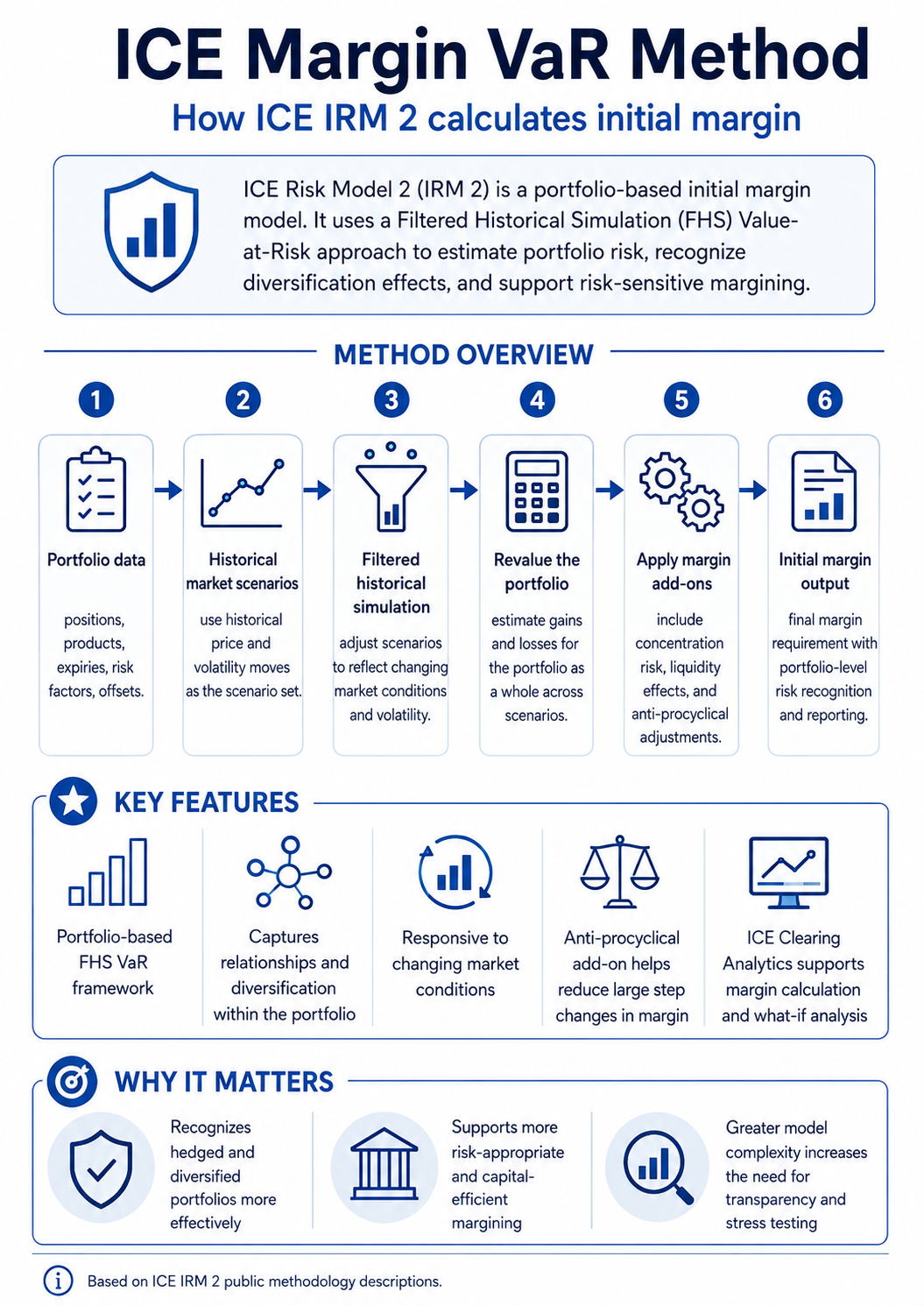
Clearing house margin models are becoming more complex and, in many respects, closer to capturing real-world market dynamics. CME’s SPAN 2 and ICE’s IRM 2 both reflect that direction. They are designed to make initial margin more risk-sensitive, portfolio-aware and responsive to changing market conditions. From a risk-management perspective, that is positive. But it creates an important asymmetry: the clearing house understands the model, while clearing members, clients and even supervisors mainly see the output — the margin call.
That asymmetry matters because margin is not only a risk measure. It is a liquidity demand. When a central counterparty raises initial margin, banks, brokers, funds, commodity traders and end-users must mobilise cash or eligible collateral. In calm markets this is manageable. In stressed markets, sudden or poorly explained margin increases can transmit liquidity stress through the financial system.
The supervisory question is therefore not whether VaR-based margining is inherently appropriate. The better question is: can the model’s behaviour be explained, anticipated and stress-tested when markets are under pressure?
Chronology: how the two models evolved
| Period | CME SPAN 2 | ICE IRM 2 | Supervisory significance |
| Legacy phase | Original SPAN became the widely used scenario- and risk-array margining standard. | ICE used the earlier ICE Risk Model framework for initial margin calculation. | Older frameworks were easier to understand but less adaptive to portfolio complexity. |
| 2019 | CME announced SPAN 2 as the next generation of SPAN, adding new modelling, reporting and margin-replication capabilities. | — | CME signalled a shift from rule-based familiarity toward historical VaR-based risk sensitivity. |
| 2021 | Continued development and testing. | ICE announced IRM 2, a VaR-based portfolio margining methodology using filtered historical simulation. | Both CCPs were moving toward portfolio-aware VaR-based margining. |
| 2023 | CME published the SPAN 2 margin framework, describing phased implementation by product grouping. | ICE continued preparing and implementing IRM 2 across relevant markets. | Margin reform moved from concept to operational readiness. |
| 2024–2025 | Phased rollout of SPAN 2 across selected product groups, supported by testing and margin tools. | ICE expanded IRM 2 implementation and developed margin analytics tools. | Focus shifted to member readiness, system adaptation, transparency and liquidity preparedness. |
| Current state | SPAN 2 is positioned as a historical VaR framework with dynamic product- and portfolio-level adjustments and enhanced reporting. | IRM 2 is positioned as a portfolio-based filtered historical simulation model with diversification recognition and anti-procyclical features. | Both models improve risk capture but increase the need for explainability and stress-test alignment. |
Comparison of CME SPAN 2 and ICE IRM 2
| Area | CME SPAN 2 | ICE IRM 2 |
| Core model | Historical Value-at-Risk framework. | Filtered Historical Simulation Value-at-Risk framework. |
| Design emphasis | Evolution of the established SPAN architecture. | Portfolio-first model designed to assess portfolio behaviour as a whole. |
| Risk sensitivity | Granular and dynamic adjustments at product and portfolio level. | Captures relationships, hedges and diversification effects within the portfolio. |
| Reporting focus | Enhanced reporting across market risk, liquidity and concentration. | Portfolio-level margin calculation, add-ons and what-if analytics. |
| Operational tools | Margin replication and approximation capabilities. | ICE Clearing Analytics for margin calculation and what-if analysis. |
| Supervisory strength | Builds on a familiar margining framework while improving risk sensitivity. | Strong recognition of diversification and portfolio relationships. |
| Supervisory concern | Complexity of new components and the need for clear attribution. | Model opacity, offset behaviour and liquidity impact under stress. |
CME describes SPAN 2 as a historical VaR framework using historical data to model how a position or portfolio may gain or lose value across different risk scenarios. It notes that SPAN 2 allows granular and dynamic margin adjustments and provides enhanced reporting on market risk, liquidity and concentration. ICE describes IRM 2 as a portfolio-based model using filtered historical simulation, responsive to changing market conditions and supported by anti-procyclical features intended to avoid large step changes in margin.
The common benefit: better alignment with real-world risk
Both models address a genuine weakness in older approaches. Modern cleared portfolios are not easily captured by fixed shocks or purely product-level calculations. Exposures cut across contracts, maturities, commodities, currencies and client segments. Volatility can change quickly. Correlations can break down. Liquidity can disappear at the moment it is most needed.
A more dynamic margin model can respond better to these realities. It can raise margin when risk is building, recognise real hedges, avoid crude over-margining and support more efficient use of collateral. In this sense, SPAN 2 and IRM 2 represent a necessary evolution in clearing risk management.
The common risk: explainability asymmetry
The same sophistication creates a new supervisory issue. A clearing member may receive a sharp margin increase without knowing whether it was driven by volatility, correlation shifts, stress calibration, liquidity add-ons, concentration risk, reduced offsets, anti-procyclical buffers or model recalibration.
The result is an information asymmetry running through the chain. The clearing house understands the model design, assumptions and calibration. The clearing member sees the output. The client may see only the collateral call. Supervisors receive validation material, but still need to understand how the model behaves under stress.
This is not a narrow transparency concern; it is a financial-stability concern. Large and unexpected changes in initial margin can propagate liquidity strains in centrally cleared markets, and the Bank of England’s 2025 draft supervisory statement on CCP margin explicitly links margin model design and revisions to procyclicality and financial-stability risk (Bank of England, 2025).
Supervisory perspective: accuracy is not enough
For supervisors, the key issue is not choosing between SPAN 2 and IRM 2. Both can strengthen risk capture. Both can support more risk-appropriate margining. Both can also become difficult to explain if attribution, simulation and stress testing are weak.
The supervisory lens should therefore move from model approval to model behaviour. A VaR-based CCP margin model should be assessed not only by its back-testing performance or statistical coverage, but also by its operational explainability.
Supervisors should expect clearing houses to demonstrate:
| Supervisory expectation | Practical implication |
| Margin attribution | Members should understand whether margin changed because of market risk, volatility, liquidity, concentration, offsets or model recalibration. |
| Simulation tools | Members should be able to estimate margin under current, hypothetical and stressed portfolios. |
| Model-change impact analysis | Material changes should be communicated with quantitative impact and adequate notice. |
| Anti-procyclicality testing | The model should balance responsiveness with stability during volatile markets. |
| Liquidity impact analysis | Stress testing should show whether margin calls create concentrated collateral pressure. |
| Governance and validation | Boards, risk committees and supervisors should receive explainable evidence, not only statistical validation. |
The European regulatory direction is consistent. ESMA’s final report on draft RTS for margin transparency under EMIR 3 strengthens requirements on margin model information and margin simulation tools for CCPs, clearing members and clients (ESMA, 2026).
Threads that converge
This piece sits at the intersection of three themes
- In Rethinking Intraday Liquidity Risk Management Under Geopolitical Risk (Roy, 2026a), I argued that the post-2008 intraday liquidity frameworks were calibrated for a stress topology that no longer dominates — sudden wholesale-funding withdrawal and counterparty credit shocks — and that today’s threat profile, particularly geopolitical shocks, generates intraday stress that is faster in onset, more concentrated by currency and jurisdiction, and not amenable to resolution through conventional central-bank facilities. That paper also noted explicitly that higher exchange-rate volatility driven by geopolitical tensions can trigger margin calls that spike intraday liquidity demand. This is the same mechanism, viewed from the other side of the wire. A VaR-based clearing house margin model is, in liquidity terms, a generator of intraday demand. When SPAN 2 or IRM 2 raises initial margin in response to a volatility spike, correlation break, or concentration add-on, the clearing member faces an intraday cash call. If that call lands in a currency whose nostro is constrained, or in a window when correspondent credit is being withdrawn, the model has not merely “captured risk better” — it has imported a new dimension of liquidity risk into the member’s treasury operation. Supervisors evaluating SPAN 2 and IRM 2 should not look only at the CCP’s own default waterfall; they should ask whether the model’s margin trajectory, under stress, is internally consistent with the intraday liquidity assumptions of the clearing members it depends on.
- In Handbook of Financial Stress Testing, there is a chapter is on CCPs — not because clearing houses are exotic, but because their stress dynamics are uniquely interconnected. Default waterfalls, liquidity shortages and margin behaviour cannot be assessed with the same methodologies used for a single bank’s capital position. They demand network-aware, behaviour-aware, and forward-looking scenario design. That review also made the point that scenario design must capture emerging risks — geopolitical instability, pandemics, climate — not just rerun historical episodes. This applies the same lens to margin modelling itself. A historical VaR or filtered historical simulation model is, by construction, anchored in observed history. Its strength lies in adapting to changing volatility and correlation regimes within that history; its weakness is the same as every backward-looking model — it has limited predictive power for stress topologies with no close historical precedent. The CCP stress-testing programme, therefore, is not an adjunct to the margin model; it is the place where the model’s blind spots are tested. If SPAN 2 and IRM 2 are to earn supervisory comfort, the stress framework around them must answer questions that the model itself cannot: what happens when historical correlations stop being informative, what happens when offsets collapse simultaneously across products, and what happens when the resulting margin call lands in a stressed funding environment.
- The need for Explainability : In Explainability of Supervisory Rating: A Pillar of Credible Risk-Based Supervision (Roy, 2026b), and in a series of related blogs comparing the FDIC CAMELS and OSFI supervisory frameworks, I have argued that the credibility of any risk-based supervisory system rests on whether the affected institution can understand why the supervisor has reached a particular conclusion. Statistical performance is necessary but not sufficient. A rating, a capital add-on or a model output that cannot be attributed to identifiable drivers tends to lose authority over time, however technically correct it may be. The same principle applies, with even sharper force, to CCP margin. A margin call is not a private supervisory judgement; it is a public liquidity event that may move through banks, brokers, funds and end-clients within hours. If the clearing member cannot decompose the call into volatility, correlation, concentration, liquidity, anti-procyclicality and model-recalibration components, the call is, functionally, a black box. Black-box margin in a stressed market is a financial-stability problem, not a transparency inconvenience. This is why I treat margin attribution, simulation tools and model-change impact analysis as supervisory expectations of the same character as ratings explainability — they are what makes the model defensible when it produces an uncomfortable answer.
Put together, the three threads suggest a particular reading of the current direction of travel. CME SPAN 2 and ICE IRM 2 are technically sophisticated improvements over what came before. But their supervisory value will be determined less by their internal mathematics than by three external conditions: whether their margin calls can be absorbed by the intraday liquidity infrastructure that members actually operate, whether their stress frameworks honestly probe the topologies the models cannot see, and whether their outputs are explainable to the people who have to fund them. None of these is a model-design question. All three are governance questions — and that is precisely where supervisors, rather than CCP risk teams alone, have to lead.
______________________
Bank for International Settlements. (2025). Transparency and responsiveness of initial margin in centrally cleared markets: Review and policy proposals. Basel Committee on Banking Supervision, Committee on Payments and Market Infrastructures, and International Organization of Securities Commissions. https://www.bis.org/bcbs/publ/d590.htm
Bank of England. (2025). Draft supervisory statement on CCP margin. https://www.bankofengland.co.uk/paper/2025/ss/supervisory-statement-on-ccp-margin
CME Group. (2023). CME SPAN 2 margin framework. https://www.cmegroup.com/clearing/files/cme-span-2-margin-framework.pdf
CME Group. (n.d.). SPAN 2 methodology and functionality. https://www.cmegroup.com/clearing/risk-management/span-overview/span-2-methodology.html
European Securities and Markets Authority. (2026). Final report on the draft RTS on margin transparency requirements. https://www.esma.europa.eu/sites/default/files/2026-03/ESMA91-1505572268-4509_Final_Report_on_the_Draft_RTS_on_Margin_Transparency_requirements.pdf
Intercontinental Exchange. (n.d.-a). ICE Risk Model 2. https://www.ice.com/clearing/margin-models/irm-2
Intercontinental Exchange. (n.d.-b). ICE Risk Model 2 methodology. https://www.ice.com/clearing/margin-models/irm-2/methodology
Roy, S. (2025a, March 20). A compelling exploration of financial stress testing [Blog post]. Sunando Roy – On Banking, Finance and Society. https://sunandoroy.org/2025/03/20/a-compelling-exploration-of-financial-stress-testing/
Roy, S. (2026a, March). Rethinking intraday liquidity risk management under geopolitical risk: Frameworks, fragilities, and the path forward. Sunando Roy – On Banking, Finance and Society. https://sunandoroy.org/liquidity-management-in-financial-sector/
Roy, S. (2026b, January). Explainability of supervisory rating: A pillar of credible risk-based supervision. ResearchGate. https://doi.org/10.13140/RG.2.2.10150.18244


Leave a Reply